Sony: FHIBE - The People Behind the Data
The Creative Brief
This film explores one of the most difficult problems in modern computer vision research: the way human data gets scraped, without consent, to train the systems that increasingly shape our lives. Sony’s answer is FHIBE — the first publicly available, globally diverse, consent-based image dataset for evaluating bias in computer vision — built on the principle that data should be collected with consent, fair compensation, and dignity.
The director (Paula Chowles) wanted the music to do two things at once: carry the real human stakes of the problem, and leave room for hope in Sony's path forward. The emotional spine of the film is Alice Xiang, who grew up feeling unrepresented in STEM and now leads the charge for ethical representation in computer vision models. The score had to hold both the gravity of the problem and the humanity of the people working to fix it.
Developing the Concept
The central idea was a conversation between two worlds: the warmth of acoustic instruments and the colder, alien textures of synthesis. That tension is the film — a story about keeping the human at the center of a system that usually erases them.
I built the emotional foundation on cello and viola for warm low and mid-range frequencies, with piano carrying the more delicate, intimate moments — instruments an audience recognizes in their body. Against that, I used synthesis for alien textures, rhythmic momentum, and the film's data-and-technology subject. Tela, a modal synthesis instrument, gave me otherworldly warped tones that were perfect for the film's moments of distorted reflection — the opening with Alice Xiang, and the web-scraping sequence where faces appear in broken-glass fragments. Fast arpeggios carried urgency and speed.
The decision I'm proudest of was about how human to let the music be. On a film about not over-correcting people into a system, I resisted the instinct to over-produce and over-quantize. I let the performances breathe. It would have felt dishonest to make a sterile score about the value of human imperfection.
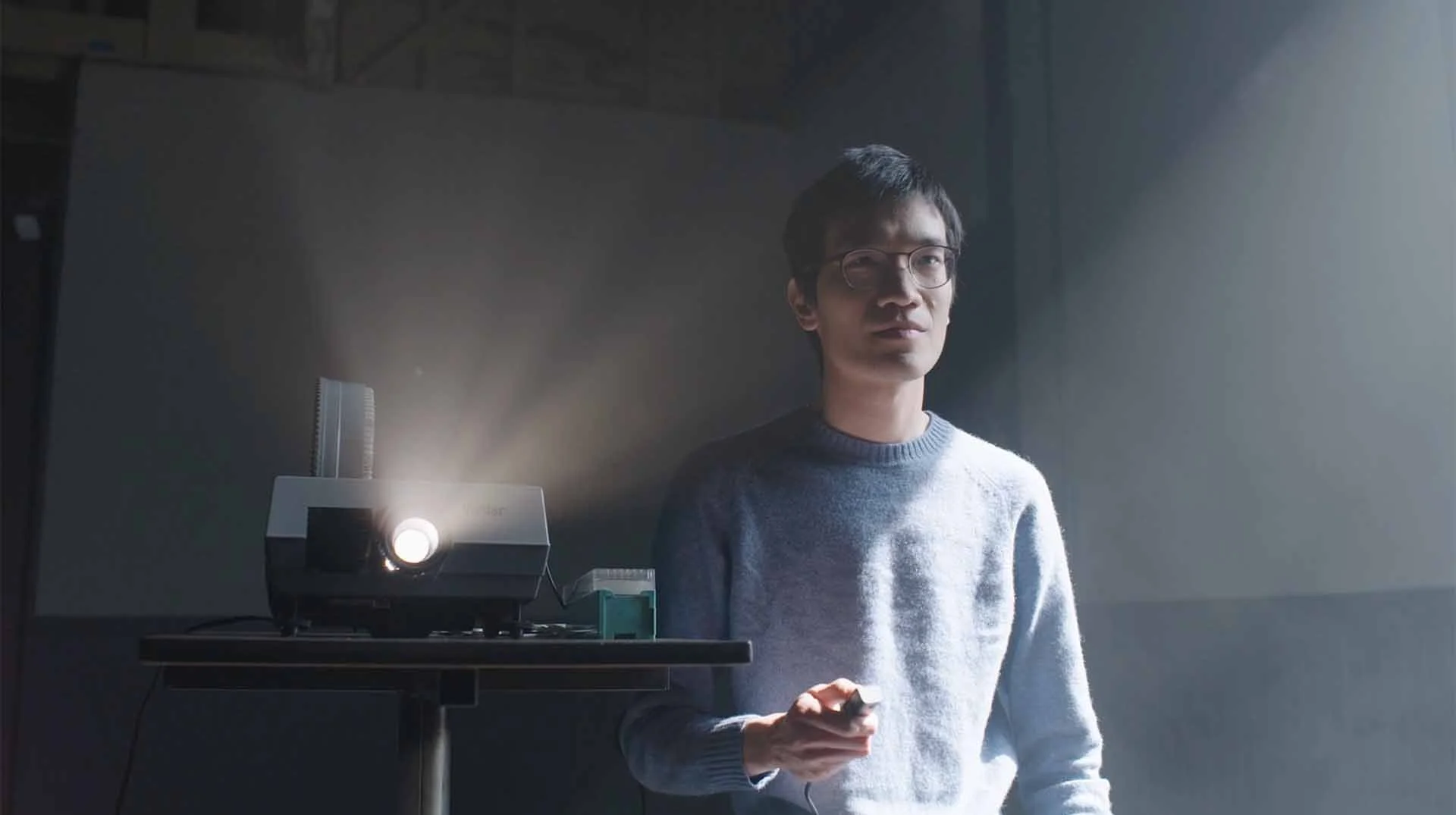
Iterating to Picture
My first demos were written from conversation rather than to picture, and it showed — too busy, too beat-driven, more like songs than score. Only one survived into the final cut. The first pass written to picture is where the real foundation came together: we locked the palette and found the emotional direction for each cue.
From there it was refinement against a moving target. The cut I first scored ran 11:38; the final came in at 9:00, which meant constant restructuring and close attention to scene transitions. One note I remember vividly was to make the opening more warped and bendy, leaning into the perspective distortions of the mirror shots — which pushed me further into Tela's textures. Seven versions to picture got the score tightly locked to the edit.
Takeaways
We're in the middle of a frenzy around AI, and I don't hear enough people talking about the quiet normalization of taking people's data without their consent. Working on a film that takes it seriously, and offers a vision of doing better, meant a lot to me; especially as an artist who values the work of real human effort.
It also clarified something about my own work. If a prompt-based AI tool can generate a perfectly mixed and mastered score — and it can — then what am I bringing to the table? For me, the answer is that I care enough about the story and the people in it to feel something. I can feel anger at the state of unethical data scraping. I can feel hope for a better future. And I get to channel that into music an audience feels too. On a film about human dignity, letting that humanity shine through was the whole point.